More sensors. More video. Limited attention.
Drones, ground vehicles and fixed cameras generate more information than operators can continuously assess. Streaming everything to a remote command centre puts pressure on communications and leaves critical analysis dependent on connectivity.
- Too many feeds. Separate streams compete for the same operator’s attention.
- Limited bandwidth. Continuous video transmission is costly on constrained links.
- Fragmented observations. Each sensor and platform sees only part of the picture.
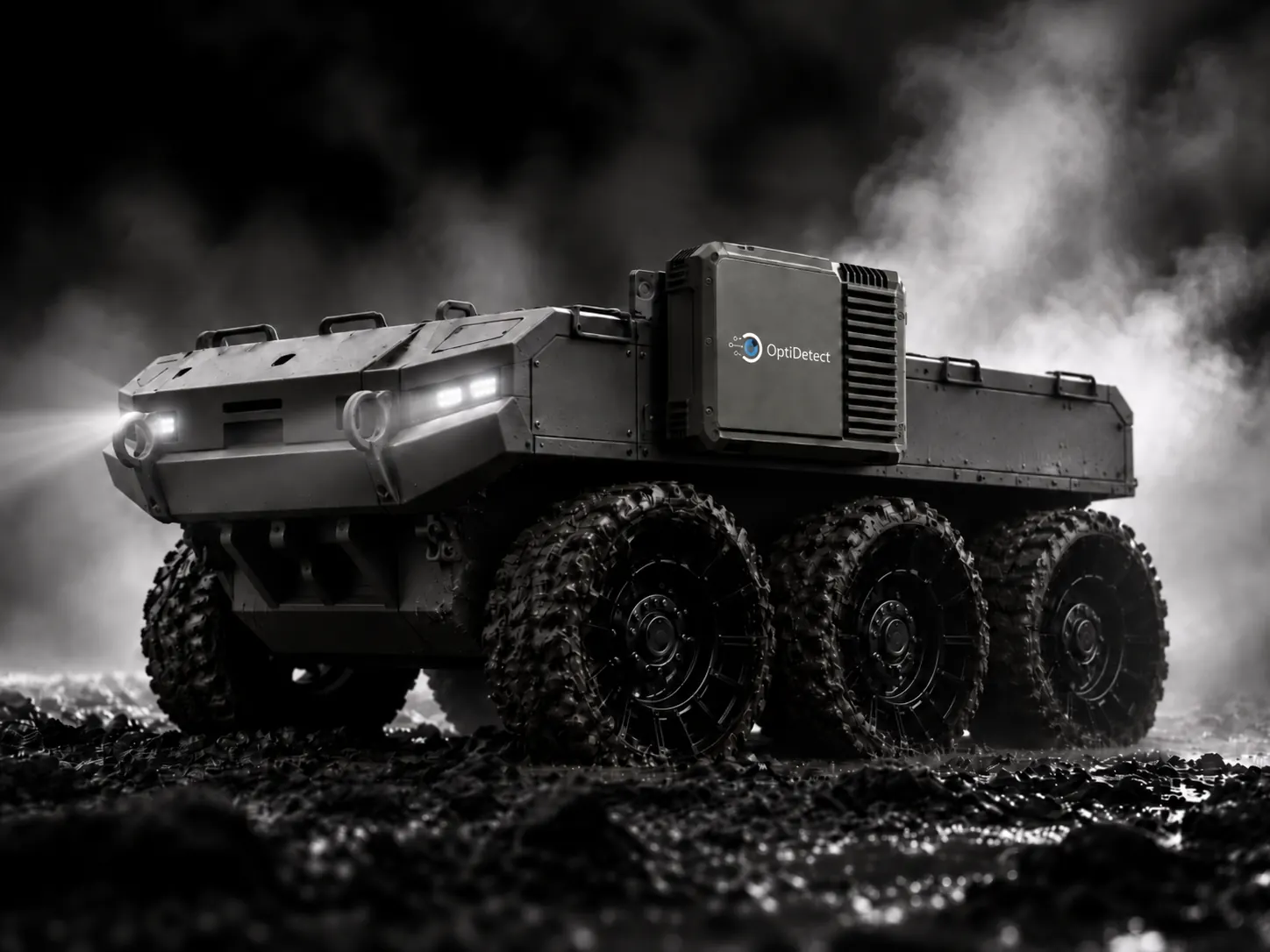
Concept visualisation: OptiDetect EDGE AI node on a third-party ground vehicle.
In development
Turn sensor data into situational awareness. Locally.
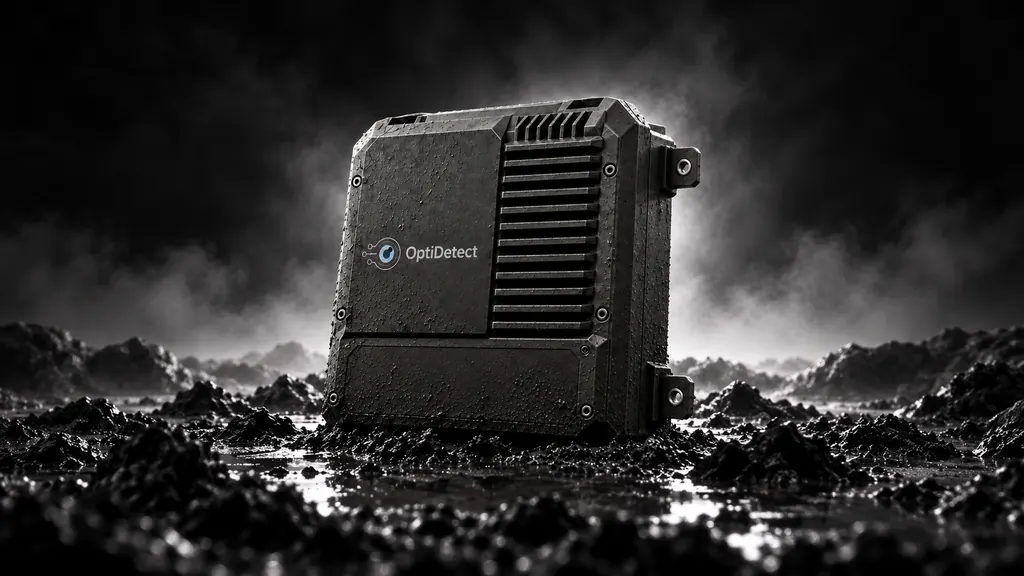
OptiDetect is developing an EDGE AI node that processes video, telemetry and sensor inputs close to where they are collected. It combines computer vision and multimodal AI to help operators understand what is happening and receive the information that matters.

Connected through local 5G. Intelligence processed at the edge.
A local 5G network carries sensor data between connected platforms and the OptiDetect EDGE AI node. The node analyses available inputs locally and shares prioritised events, tracks and selected evidence with operators and connected systems.
-
Platforms and sensors
- UAVs
- UGVs
- Fixed cameras
- Other sensors
-
Local 5G network
Private or local network connecting compatible platforms and sensors
-
OptiDetect EDGE AI node
Local analysis and interpretation
Optional exchange with neighbouring EDGE AI nodes
-
Operators and command systems
Receive prioritised events, tracks and selected evidence
5G provides connectivity. OptiDetect provides AI processing and interpretation.
The node is not a 5G base station. It attaches to the local network as a processing endpoint.
Local processing continues without backhaul. If the external link is lost, analysis can continue while power and local sensor connections remain available.
Integration notes
- Sensors and platforms need compatible connectivity to the local network, or an integration gateway.
- If the link between a sensor and the node is lost, live input from that sensor is interrupted until the link returns.
- Like any radio network, 5G can be affected by interference and coverage conditions. It does not guarantee uninterrupted operation.
- Integration requirements depend on your platforms and interfaces. Talk to us about your set-up.
What happens inside the node
-
Sense
Receive video, telemetry and connected sensor inputs.
-
Understand
Apply computer vision and multimodal AI to identify relevant objects and events.
-
Fuse
Combine observations across sensors and time to build a more coherent picture.
-
Share
Deliver prioritised events, tracks, confidence levels and selected evidence to operators and connected systems.
Operators receive structured information instead of having to interpret every raw feed continuously. Selected video can still be requested when it is needed.
Local awareness. A shared operational picture.
In the intended architecture, several nodes each process their own local inputs and exchange selected information with each other when links are available.
Demonstrated in industrial Edge AI
- Computer vision inference on local edge hardware
- Vision-language models for inspection and process monitoring
Development objectives
- Multi-node synchronisation
- Predictive awareness
- Advanced collaborative sensing
The system supports operator judgement. People remain responsible for mission decisions.
One capability set. Two domains.
Both domains use the same underlying capabilities: local inference, computer vision, multimodal interpretation and sensor fusion.
Defence and security
- Unmanned-platform situational awareness
- Distributed surveillance and reconnaissance
- Perimeter and critical infrastructure monitoring
- Operator decision support
Civil and industrial
- Manufacturing quality control
- Production-process monitoring
- Logistics and cargo inspection
- Infrastructure analytics
Connect your platforms. Make sense of your data.
Talk to OptiDetect about your sensors, platforms and integration requirements.
Discuss an integration